



Time to read :
1 min read
A logistics software platform rarely works alone.
It needs to exchange data with carriers, warehouses, ERPs, payment systems, mapping services, tracking devices, and customer communication tools. Without these connections, teams often move data between systems manually, which slows operations and creates room for errors.
That is where API integration becomes critical.
For a logistics software platform, APIs are not simply a way to connect two applications. They create the data layer that allows orders, shipments, vehicles, inventory, payments, and delivery events to move through the business without manual intervention.
The most useful integrations depend on the platform's purpose. A last mile delivery platform may need mapping, GPS, carrier, and notification APIs first. A freight management platform may need TMS, ERP, carrier, and tracking integrations.
Below are the 10 API integrations we consider most valuable when designing a modern logistics software platform, along with what each integration should actually do and when it makes sense to use it.
Which API integrations does a logistics software platform need?
A logistics platform should usually consider these 10 integration categories:
API integration | Primary purpose |
Carrier APIs | Shipment booking, rates, labels, tracking |
Shipping APIs | Shipping workflows across multiple providers |
ERP APIs | Orders, customers, finance, inventory data |
TMS APIs | Transport planning and freight management |
WMS APIs | Warehouse and fulfillment operations |
Tracking APIs | Real time shipment and vehicle visibility |
Mapping APIs | Routes, distances, ETAs, geocoding |
Payment APIs | Online payments, refunds, transaction status |
Address APIs | Address validation and location accuracy |
Communication APIs | SMS, email, push, and delivery alerts |
The important point is that these integrations should not be added just because they are available.
Each one should support a specific business workflow.
1. Carrier API Integration
Carrier integration is often the first major integration requirement for logistics software.
A logistics platform may need to work with several carriers. Each carrier can have different APIs, data structures, authentication methods, service codes, and tracking events.
A good integration layer hides that complexity from the end user.
For example, a shipment booking flow could work like this:
Create order → Validate address → Calculate carrier rates → Select service → Create shipment → Generate label → Receive tracking number
The user should not have to open a separate carrier portal for each step.
A carrier integration can support:
Rate requests
Shipment creation
Label generation
Tracking numbers
Pickup requests
Shipment cancellation
Delivery status
Proof of delivery
Estimated delivery dates
Why it matters
Multi-carrier support allows logistics businesses to compare services and route shipments based on cost, delivery time, service area, or carrier availability.
From a software architecture perspective, this is also where an adapter or connector layer becomes valuable.
Instead of building the core application around one carrier's API structure, the platform can create a common internal model and map each carrier's API to it.
That makes adding another carrier much easier later.
2. Shipping API Integration
Carrier APIs and shipping APIs overlap, but they solve different problems.
A shipping API can provide a unified interface for shipping operations across several providers.
This becomes useful when a logistics platform needs to support multiple shipping partners without creating a completely separate workflow for every provider.
For example, the platform might request:
Available services
Shipping cost
Delivery estimate
Shipment creation
Shipping label
Tracking information
The application can then present these options through one interface.
A practical use case
Imagine an ecommerce logistics platform processing 20,000 shipments each month.
Without a unified shipping integration, the development team may need separate business logic for every carrier.
With a normalized integration layer, the core platform can work with a standard shipment object while each provider handles its own API-specific requirements.
This is more than a development convenience. It can reduce long-term integration complexity as the platform grows.
3. ERP API Integration
ERP integration connects logistics operations with the company's broader business system.
An ERP may contain the order, customer, product, inventory, billing, or financial data that the logistics platform needs.
The logistics platform should not force users to enter that information again.
A typical flow could be:
ERP order → Logistics platform → Shipment planning → Carrier booking → Tracking updates → ERP
For example, when an order is approved in an ERP, the logistics platform can receive the order automatically.
Once the shipment is delivered, the logistics platform can send the delivery status back.
What should be integrated?
The exact data depends on the ERP and business process, but common objects include:
Sales orders
Customer records
Product information
Inventory availability
Delivery addresses
Invoices
Shipment status
Returns
One important architecture decision is data ownership.
The logistics platform should not blindly copy every ERP record.
The integration should define which system is the source of truth for each data type. This prevents conflicting updates and duplicate records.
4. TMS API Integration
A Transportation Management System handles transport planning and execution.
If the logistics platform already includes transportation management features, direct TMS integration may not be necessary.
But when a company already uses a TMS, integrating it can prevent teams from working across disconnected systems.
A TMS integration can exchange information such as:
Loads
Orders
Routes
Drivers
Vehicles
Carriers
Delivery schedules
Freight costs
Transport status
For example, the logistics platform may send approved shipments to the TMS. The TMS can then assign loads and transportation resources.
The resulting transport plan can flow back into the logistics platform.
When is TMS integration useful?
It is particularly useful when the logistics platform is being added to an existing technology stack rather than replacing the entire transportation system.
This is a common situation in enterprise logistics.
The goal should be to connect systems where they add value, not rebuild functionality that the company already operates successfully.
5. WMS API Integration
A delivery does not begin when a truck leaves the warehouse.
It begins when the order is prepared.
That makes Warehouse Management System integration important for many logistics platforms.
A WMS can provide information about:
Inventory
Picking
Packing
Order readiness
Warehouse locations
Dispatch
Returns
Consider a simple fulfillment workflow:
Order received → Inventory allocated → Product picked → Order packed → Shipment created → Carrier pickup
The logistics platform needs to know when the order is actually ready for transportation.
A WMS API can provide that event automatically.
This prevents a carrier or driver from being assigned to an order that has not been packed.
The bigger benefit
WMS integration creates a connection between warehouse execution and transportation execution.
That gives operations teams a more complete view of the order lifecycle.
6. Real Time Tracking API Integration
Customers do not simply want to know whether a shipment exists.
They want to know where it is and when it will arrive.
Tracking APIs bring shipment events and location data into the logistics platform.
Depending on the data source, the platform may receive:
Pickup confirmation
In-transit events
Vehicle location
Delivery attempts
Delay events
Estimated arrival
Delivery confirmation
The platform can then use these events to update dashboards, trigger alerts, and provide customer visibility.
Do not confuse tracking with useful visibility
Receiving GPS coordinates every few seconds does not automatically create a good tracking product.
The platform needs to turn raw location data into useful events.
For example:
Raw data: Vehicle is 4.8 km from destination.
Useful product information: Driver is approaching the delivery location. Estimated arrival is 12 minutes.
That distinction matters when designing logistics software.
The value is not the data itself. The value comes from what the platform does with it.
7. GPS and Mapping API Integration
Mapping APIs provide the geographic intelligence behind many logistics workflows.
They can support:
Geocoding
Reverse geocoding
Route calculation
Distance calculation
Travel time
ETA calculation
Route visualization
Delivery zones
Driver navigation
For a last mile platform, this integration can sit at the center of dispatch operations.
Suppose a dispatcher has 30 deliveries and 8 drivers.
The platform can use location and route data to help assign deliveries based on factors such as:
Distance
Delivery windows
Vehicle capacity
Driver location
Traffic conditions
Priority
The exact optimization logic belongs in the logistics platform rather than being assumed to come from the mapping API.
That is an important distinction.
Mapping APIs provide geographic data and services. Your logistics software provides the business logic.
8. Payment API Integration
Payment integration becomes essential when the logistics platform collects money from customers, merchants, drivers, or business accounts.
A payment integration can support:
Payment collection
Payment status
Refunds
Transaction records
Payment links
Recurring billing
Failed payment handling
For example:
Shipment booked → Price calculated → Payment initiated → Payment confirmed → Shipment released
The payment status should be linked to the shipment or order in the platform.
Build payment logic around events
Payment processing should not depend only on the response shown after checkout.
The platform should also handle asynchronous payment events, such as successful payment confirmation, failure, refund, or dispute where supported by the payment provider.
This is important because payment status can change after the initial request.
The integration should also follow the provider's security requirements and avoid unnecessary handling of sensitive payment data.
9. Address Validation API Integration
Address quality has a direct impact on delivery performance.
A customer may enter:
123 Main St, New York
when the actual delivery requires a more complete address.
An address API can help validate, standardize, and enrich location data before the shipment is created.
It may help with:
Postal code validation
Address formatting
Missing address information
Geographic coordinates
Location matching
Duplicate location issues
This is particularly useful in last mile logistics, where small address errors can create failed delivery attempts and additional operating costs.
Where should validation happen?
Ideally, address validation should happen early in the workflow.
For example:
Customer enters address → Address validated → Location confirmed → Shipping rate calculated → Shipment created
Validating the address after the shipment has already been booked is far less useful.
10. Communication API Integration
Logistics creates a large number of events that customers and internal teams need to know about.
Communication APIs can connect the logistics platform to SMS, email, push notification, or messaging services.
Typical events include:
Order confirmed
Shipment created
Pickup scheduled
Shipment in transit
Delivery delayed
Driver approaching
Delivery completed
The important part is to connect notifications to business events, not simply send messages at fixed times.
For example:
Shipment status = Out for Delivery
can trigger a customer notification.
Shipment status = Delayed
can trigger a customer message and an internal operations alert.
This event-driven approach makes communication more reliable and easier to manage as the platform grows.
How These Integrations Should Work Together
The biggest mistake in logistics software development is treating every API as an isolated feature.
The real value comes from connecting them into a complete workflow.
Consider an ecommerce fulfillment platform:
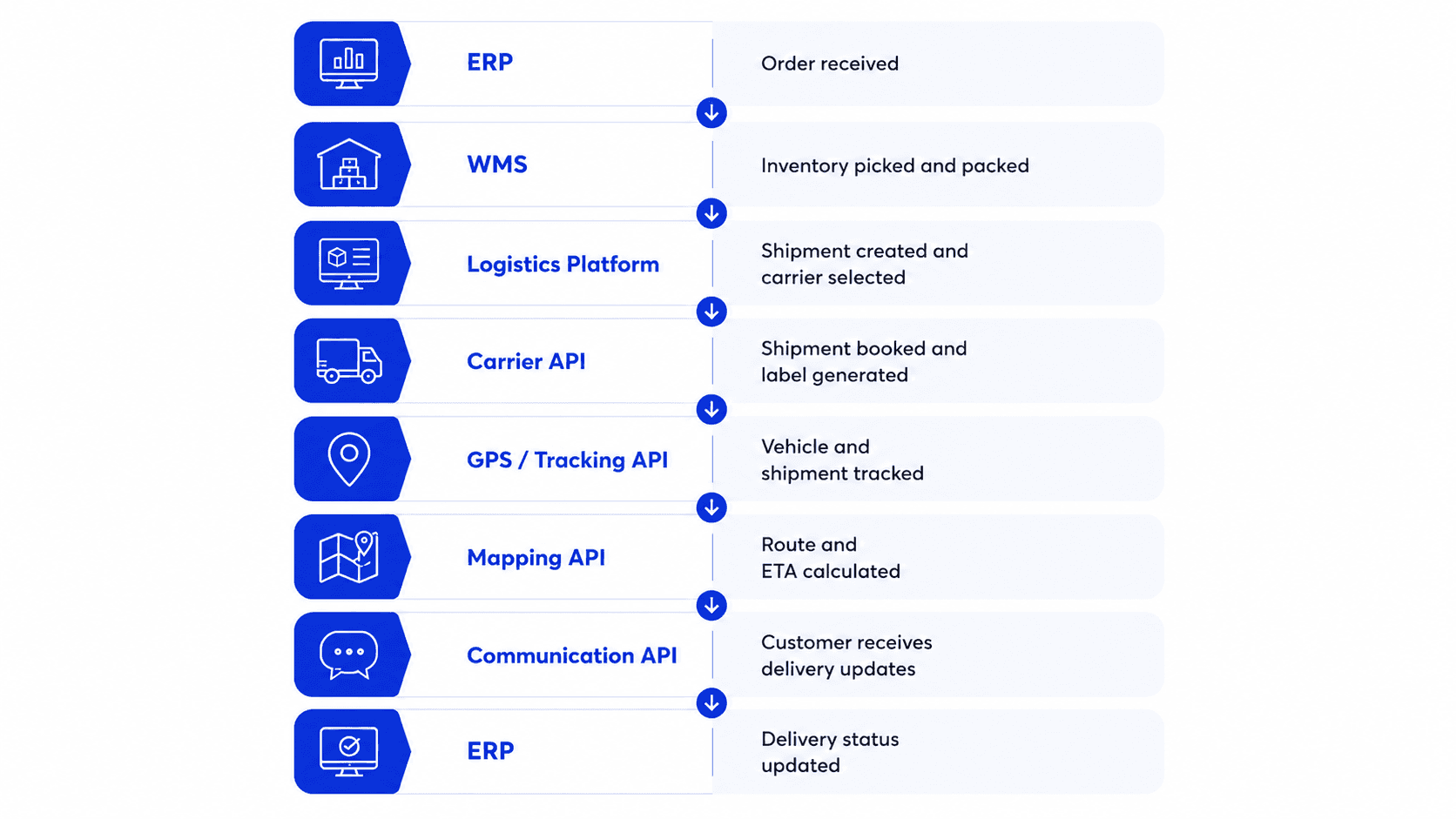
The user sees one workflow.
Behind the scenes, several systems are communicating through APIs.
That is what a well-designed logistics platform should accomplish.
What to Consider Before Building Logistics API Integrations
Choosing the APIs is only the first step.
The integration architecture also needs to account for how data will move, fail, retry, and scale.
Use a Common Data Model
Different providers may represent the same object differently.
One carrier may call a shipment status "IN_TRANSIT."
Another may use "IN_TRANSIT_PICKED_UP."
Your application should normalize these values into a common internal model.
This keeps the business logic independent from individual providers.
Design for API Failures
External APIs will sometimes fail.
Requests can time out. Providers can have outages. Authentication can expire. Rate limits can be reached.
Your platform should have:
Retry logic
Timeouts
Error queues
Logging
Failure alerts
Idempotency controls
Fallback handling where appropriate
A failed carrier request should not create two shipments when the request is retried.
That is why idempotency matters in shipment and payment workflows.
Use Webhooks for Events
Polling an API every few seconds is not always the best approach.
When a provider supports webhooks, it can send an event to your platform when something changes.
For example:
Carrier → Shipment Delivered → Webhook → Logistics Platform → Database Updated → Customer Notified
This can reduce unnecessary API requests and provide faster updates.
Plan for Rate Limits
External providers often impose API request limits.
A platform that works well with 500 shipments may behave very differently at 500,000 shipments.
Caching, queues, batching, and controlled retries can help manage API traffic.
This needs to be considered during architecture planning rather than after the platform starts experiencing API failures.
Secure Every Integration
API credentials should never be exposed in client-side code.
The platform should use secure credential storage, access controls, encryption where appropriate, and proper secret management.
Each integration should also use the minimum permissions required.
Security becomes even more important when the platform connects to ERP, payment, customer, and operational systems.
Which Integrations Should You Build First?
Not every logistics platform needs all 10 integrations at launch.
A better approach is to prioritize integrations based on the core workflow.
For a last mile delivery platform
Prioritize:
Mapping
GPS and tracking
Carrier
Communication
Address validation
For a freight management platform
Prioritize:
Carrier
TMS
Tracking
Mapping
ERP
For an ecommerce logistics platform
Prioritize:
Shipping
Carrier
WMS
ERP
Payment
The exact stack should come from the business process, existing systems, user roles, and expected shipment volume.
Build the Integration Layer Before the Integrations Scale
A logistics platform may start with one carrier and one warehouse.
That does not mean the architecture should be built only for one carrier and one warehouse.
If the product is expected to grow, the integration layer should make new providers easier to add.
A scalable approach can use:
Core logistics platform → Integration layer → Provider-specific connectors
The core platform works with standard internal objects.
Each connector handles the provider's specific API requirements.
This separates business logic from external API logic.
It also makes future integrations less disruptive.
Final Takeaway
API integration is one of the foundations of modern logistics software.
Carrier, shipping, ERP, TMS, WMS, tracking, mapping, payment, address, and communication APIs can connect the systems that run a logistics operation.
But successful integration is not about connecting the largest number of APIs.
It is about connecting the right systems in the right order and designing the architecture so those integrations remain reliable as shipment volume, users, carriers, and business workflows grow.
At Deliverables Agency, we approach logistics software development from that wider perspective. The goal is not simply to build another dashboard or connect an API. It is to build a logistics platform where orders, transportation, warehouse operations, tracking, payments, and customer communication work as one connected system.
If you are planning a custom logistics platform, our logistics software development team can help define the required integrations, data flows, architecture, and development roadmap around your actual business workflow.
Connect Your Logistics Operations in One Platform
Bring your ERP, WMS, TMS, carriers, tracking, mapping, and other business systems together with custom logistics software built around your workflows. Build a connected platform that keeps data moving across your operation.
Some Topic Insights:
What are the most important API integrations for logistics software?
Carrier, shipping, tracking, mapping, ERP, TMS, WMS, payment, address validation, and communication APIs are among the most valuable. The priority depends on the type of logistics platform and its existing technology stack.