
Time to read :
1 min read
Automation does not fail because the technology does not work. It fails because the wrong type was chosen for the job.
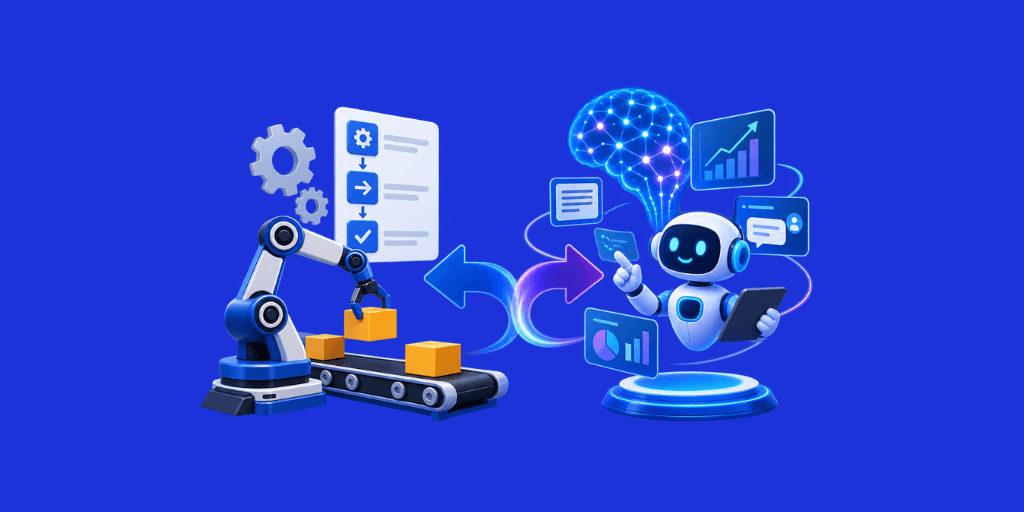
Two things get called “automation.” One executes fixed rules, the same steps, every time, exactly as programmed. It is reliable, fast to set up, but completely brittle the moment a variable appears that nobody planned for. The other reads context, learns from data, and adapts when the unexpected happens.
AI automation vs traditional automation is a matching exercise. Match the right type to the right workflow, and you recover the investment in months. Match them wrong, and you spend more maintaining the system than you ever saved by building it.
This guide gives you the framework to get that match right, by business size, workflow type, and honest cost.
AI Automation vs Traditional Automation at a Glance
Factor | Traditional Automation | AI Automation |
How it works | Fixed rules and scripts | Learns from data and adapts |
Best for | Repetitive, predictable tasks | Complex, variable, judgement-based tasks |
Handles exceptions | No, breaks on edge cases | Yes, adapts dynamically |
Setup time | Days to weeks | Weeks to months |
Upfront cost | Low to medium | Medium to high |
Long-term cost | Higher (manual maintenance) | Lower (self-improving) |
Example tools | RPA bots, macros, Zapier | LLMs, ML models, AI agents |
Scales with volume | Requires reconfiguration | Scales automatically |
Best business fit | Stable, well-designed processes | Growing, data-rich environments |
Verdict | Fast and reliable for simple work | Smarter for complex, evolving tasks |
What is Traditional Automation?
Traditional automation uses fixed rules to handle repetitive tasks. It follows an “if-then” logic. If an invoice arrives, route it for approval. If stock falls below 10 units, trigger a reorder.
It does not think, learn, or execute.
Common tools in this category include Robotic Process Automation (RPA), macros, Zapier-style workflow connectors, and scheduled scripts. These tools are effective for tasks that are structured, high-volume, and do not vary much.
Traditional automation works well when:
The process has clear and consistent inputs
Exceptions are rare and manageable manually
Speed of setup matters more than intelligence
Budget for initial build is tight
What is AI Automation?
AI automation uses machine learning, natural language processing, and pattern recognition to handle tasks that require judgement. It does not follow a fixed script, but reads context, interprets intent, learns from outcomes, and improves over time.
AI automation for businesses means a system that can read an unstructured customer email and decide how to respond, predict when a machine needs maintenance before it breaks, detect fraud in a transaction based on behavioural patterns, or recommend the next best action in a sales workflow, without a human defining every rule in advance.
According to HubSpot research, 62% of business leaders have already adopted AI and automation tools to support employee productivity. That adoption is accelerating because AI handles the workflows that traditional automation could never reach.
AI automation works well when:
Inputs vary, and exceptions are frequent
The tasks require reading unstructured data (emails, documents, images)
The process needs to improve over time with more data
You want a system that scales without proportional reconfiguration
AI Automation vs RPA: Where They Actually Differ
AI automation vs RPA is one of the most searched questions in this category.
RPA (Robotic Process Automation) is a form of traditional automation. It mimics human actions inside a digital interface, like clicking, copying, pasting, and entering data. RPA bots follow precise instructions and fail the moment the screen layout changes or an exception appears.
AI automation operates at a different level. It does not click through interfaces. It understands the underlying data, makes decisions, and can handle variation without breaking.
Here is the practical difference:
Scenario | RPA Response | AI Automation Response |
Invoice arrives in standard format | Processes automatically | Processes automatically |
Invoice arrives with missing field | Fails- flags for human review | Identifies the gaps, requests missing info, or applies learned context |
Unusual vendor behavior detected | Does not detect, processes as normal | Flags anomaly based on historical pattern analysis |
New document format introduced | Requires manual reconfiguration | Adapts based on document understanding models |
Customer query in natural language | Cannot interpret, needs form input | Reads intent, categorizes, and routes or responds |
RPA is not obsolete. It remains useful for stable, high-volume, and structured tasks. But it is a rule-follower, and AU vs traditional automation conversations that treat RPA as equivalent to AI miss this distinction early.
Who Should Use What: The Audience Framework
Here is a clear segmentation by business profile.
Best for Solopreneurs and Small Operations: Traditional Automation First
Fits well if:
Your team has fewer than 10 people
Your key workflows are simple and consistent
Budget for automation tooling is under $500 per month
You need something working in days, not months
What to use: Zapier, Make, basic RPA tools, or no-code workflow builders. Connect your email to your CRM. Automate invoice reminders. Trigger onboarding sequences from form submissions.
Not a good fit if:
You are handling large volumes of unstructured customer messages
Your workflows have frequent exceptions that break simple rules
Our recommendation: Start with traditional automation for your most repetitive tasks. Only graduate to AI when your data volume and workflow complexity justify the investment.
Best for Growing SMEs: AI Automation for Businesses
Fits well if:
You receive 50+ customer inquiries or process 100+ transactions weekly
Your team spends 3+ hours daily on tasks that vary too much for fixed rules
You want to scale without proportionally increasing headcount
You are losing leads to slow follow-up or missing patterns in your sales data
What to use: Custom AI agents for customer service, lead qualification, and support triage. AI-powered document processing for invoices and contracts. Predictive analytics for inventory or demand planning.
Not a good fit if:
Your processes are not yet documented or consistent enough to train on
You have not yet established the data infrastructure AI needs to learn from
Deliverables insight: In our work across 40% AI automation for businesses engagements, growing SMEs that automate their highest-volume variable workflows, typically customer inquiries and internal document processing, reduce manual handling within the first 90 days.
Best for Complex Enterprises: Hybrid AI and Traditional
Fits well if:
Your operation involves dozens of distinct workflows with different complexity levels
Compliance, audit trails, and data governance are non-negotiable requirements
You run operations across multiple regions, languages, or regulatory frameworks
Some workflows are stable and predictable while others require constant judgment
What to use: A deliberate hybrid. Traditional automation handles stable, structured back-office processes, like payroll triggers, invoice routing, and compliance reporting. AI automation handles the variable, high-judgment work, like customer escalations, fraud detection, supply chain exceptions, and multi-language support.
Not a good fit for pure AI only: Over-relying on AI for tasks that are genuinely stable and predictable adds cost and complexity without adding value.
When Traditional Automation is the Right Choice?
People searching for AI automation vs traditional automation rarely know when to choose the other path.
Traditional automation is genuinely the better choice when:
Your process never varies: If an invoice always arrives in the same format, from the same supplier, in the same system, RPA handles it perfectly. Adding AI adds costs without benefit.
Speed of deployment matters more than sophistication: A well-configured Zapier workflow can go live in hours. A trained AI agent takes weeks. If you need automation running before a product launch next week, traditional tools are the practical answer.
Your budget is tight: Traditional automation tools start at $20-$50 per month. A custom AI automation build starts at $8,000+. If you are in the early stages of automating your operation, the ROI math often favors traditional tools first.
Your team lacks the data infrastructure AI needs: AI learns from data. If your data is incomplete, inconsistently formatted, or stored across disconnected systems, AI automation will underperform until that foundation is built. Traditional automation can help you build consistent data while you prepare for AI.
The right AI automation company for your business will tell you when not to build AI, not only when you should.
What Does AI Automation Cost in 2026?
Here are the realistic ranges.
Automation Type | Monthly Tool Cost | Build Cost | Best For |
Traditional automation (no-code tools) | $20 – $500/month | None | Simple, structured tasks |
RPA platforms (enterprise) | $2,000 – $10,000+/month | $5,000 – $30,000 | High-volume structured data |
Off-the-shelf AI tools | $100 – $2,000/month | None | Standard AI use cases |
Custom AI automation (focused build) | $500 – $3,000/month | $8,000 – $30,000 | Specific business workflows |
Enterprise AI automation program | Custom | $40,000 – $150,000+ | Multi-workflow, multi-system |
Hidden cost to budget for in traditional automation:
Maintenance is the hidden tax of rule-based systems. Every time your process changes, someone must update the rules manually. In our experience, businesses that automate complex variable processes with traditional tools spend 40% more in maintenance within 18 months than those that started with AI automation.
Hidden costs to budget for in AI automation:
Data preparation and model training take time and infrastructure investment before a single workflow goes live. This is not a reason to avoid AI. It is a reason to scope it properly before committing.
The Bottom Line
Strip away the marketing noise around AI automation vs traditional automation and the decision comes down to one word: variation.
Traditional automation is fast, affordable, and reliable for stable, predictable, rule-consistent work. It has earned its place in every business operation that has structured data and clear rules.
AI automation is for everything else: the variable, the complex, the judgement-based. The workflows where fixed rules break by the end of the first month. The customer messages that a bot cannot route without understanding what the customer actually means. The patterns in your data that only become visible after enough examples accumulate.
The businesses that matched the right tools to each workflow and had someone who understood both well enough to tell the difference have been gaining ground today.
Choose the Right Automation for Your Business
Not sure whether AI automation, traditional automation, or a hybrid approach is right for your workflows? Our experts can assess your processes, identify the best opportunities, and recommend an automation strategy built around your goals, budget, and growth plans. Book a free strategy call today and find the right automation path for your business.
Some Topic Insights:
What is the difference between AI automation and traditional automation?
AI automation uses machine learning, natural language processing, and pattern recognition to handle variable, complex tasks. Traditional automation follows fixed rules and is best for repetitive, predictable workflows.